MICKEY
The Visual Art & Painting Suite
There is a kid right now staring at a blank canvas with no idea where to start. Not because they lack vision. Because no one ever gave them the language for what they are already seeing. They know what they want to make. They just don't know yet what it's called, how it's built, or what the person who made something like it used to get there.
And there is a painter right now — years in, a body of work behind them, a studio practice that has cost them more than they can calculate in time and money and self-doubt — who still opens a reference when they need to remember exactly how much oil a final glaze should carry, or why the violet they mixed went grey before it hit the canvas.
Mickey was built for both of them.
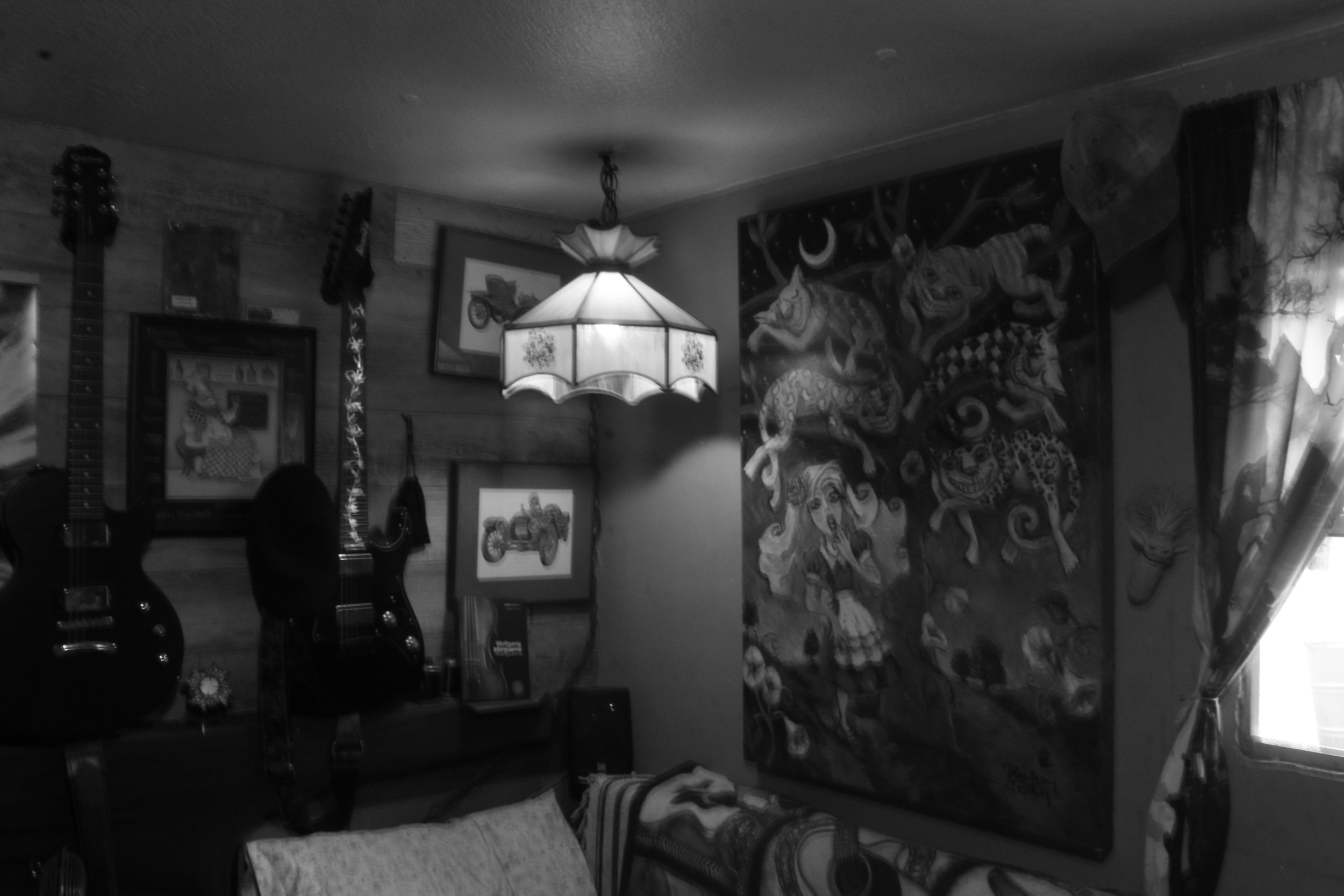
Named in honor of Mickey Ray — artist, Hollywood, Florida. Pete owns one of his paintings. Alice in Wonderland. Four Cheshire Cats, each in a different pattern — polka dots, stripes, checkerboard, leopard print — draped through a tree over Alice under a crescent moon and a full starfield. Fearless color. The kind of work that makes you stop moving and just look. Signed Mickey Ray in the bottom right corner. The painting hangs in Pete's home.
The aesthetic of this app was pulled directly from that canvas. The night sky. The star field. The crescent moon. The bold accent colors taken from Mickey Ray's own palette. This suite doesn't just carry his name — it carries his visual DNA.
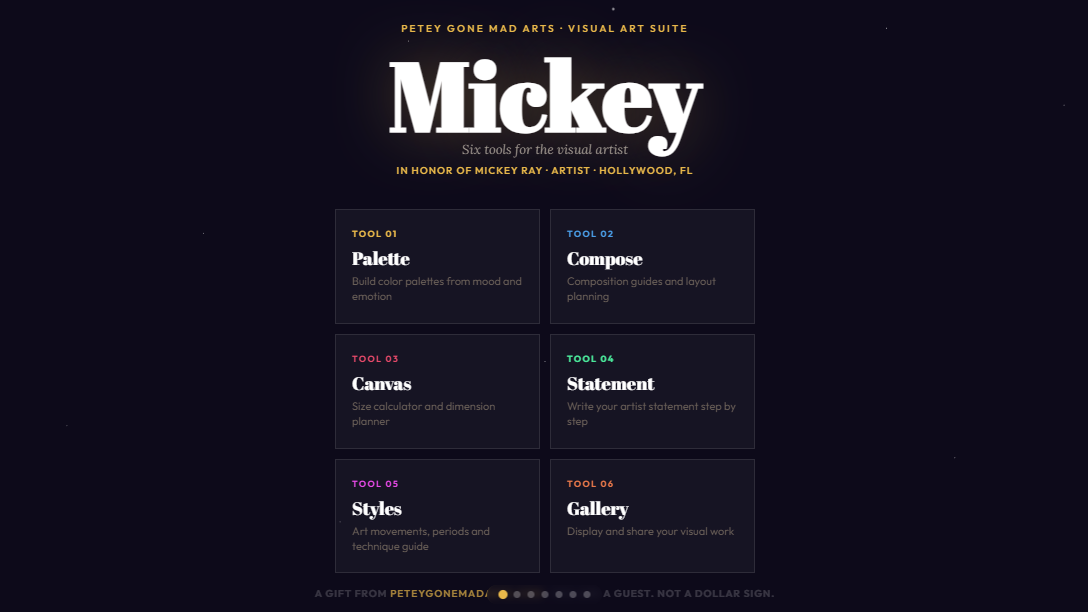
Six tools. The complete visual artist's toolkit.
Palette — Nine mood-based color palette generators — Serene, Dramatic, Joyful, Melancholy, Fierce, Mystical, Earthy, Twilight, Raw — plus four seasonal palettes. Each generates five colors with hex codes you can copy with a tap. Save every palette you build. The history of a creative process documented in color.
Compose — Seven composition guides drawn live on canvas — Rule of Thirds, Golden Ratio, Diagonal, Symmetry, Triangle, Radial, and a clear canvas for when you trust your eye completely. Three orientations. Each guide accompanied by a full written explanation of what it does and why it works. The Radial guide description names Mickey Ray's Cheshire Cat painting specifically — because it was the right example and it was already in the room.
Canvas — Size and dimension calculator for every standard canvas format — from 8×10 through 36×48 — plus custom dimensions in inches, centimetres, millimetres, and pixels. Aspect ratio, DPI equivalents at 300 and 72, physical area. The math that stands between an idea and a correctly proportioned surface.
Statement — Five guided questions that build a complete artist statement from your own words. What you make. What your work explores. How you work. Who influences you. What you want the viewer to feel. Assembled, saved, copyable. The document every artist needs and almost no one writes until someone asks for it at the worst possible moment.
Styles — Ten art movements from Renaissance through Neo-Expressionism — each with dates, key artists, a full description, and technique list. Classical and modern and contemporary. Filter by period. The reference that puts the work you make in conversation with the work that came before it, because no artist exists outside of history even when they think they do.
Gallery — Six slots for your own work. Captions. Stored locally. Nothing uploaded anywhere. Your work stays yours. And inside the Gallery, three complete reference manuals — the knowledge that belongs in every visual artist's hands:
Manual — Color Mixing Reference. Subtractive versus additive color. The painter's color wheel. How to mix clean secondaries without the result going grey. Warm and cool greys built from real pigment combinations. Skin tones from light to deep, warm to cool. The shadow and light mixing rule that every art school teaches eventually — never add black to darken, add the complementary color instead. Paint behavior across oil, acrylic, watercolor, gouache, and pastel. The science of why the violet went grey before it hit the canvas.
Manual — Medium & Materials Reference. Oil, acrylic, watercolor, gouache, and pastel — each explained honestly. What each does. What it requires. What it will not forgive. Surfaces and grounds from stretched canvas to wood panel to watercolor paper. Brushes — rounds, flats, filberts, fans, palette knives — and the rule that fewer better brushes outperform more cheap ones every time. Archival considerations and lightfastness ratings. The complete guide to understanding your tools before you touch them.
Manual — Pricing & Selling Your Work. The conversation most artists avoid until it's urgent. Formula pricing with the actual math. Market-based pricing and the consistency rule. Originals versus open and limited edition prints. Where to sell — your own site, online marketplaces, gallery consignment, art fairs. How to approach a gallery without embarrassing yourself or wasting their time. How to build a collector base. Tax and business basics for the self-employed artist. And the line that every artist who has ever underpriced their work needed to hear sooner — underpricing signals low value. Price with intention.
From the kid staring at a blank canvas, to the painter who has been making work long enough to know that the learning never stops — Mickey covers the full distance.
This is what PGMA is.
Named after a man whose fearless color work hangs on Pete's wall and reminds him every day what it looks like when an artist goes all out with no apologies. That energy is in every tool in this suite. Come in, pick up the brush, and do the same.
Free. No account. No email. No strings.
You are our guest. Not a dollar sign.