Let me write it.
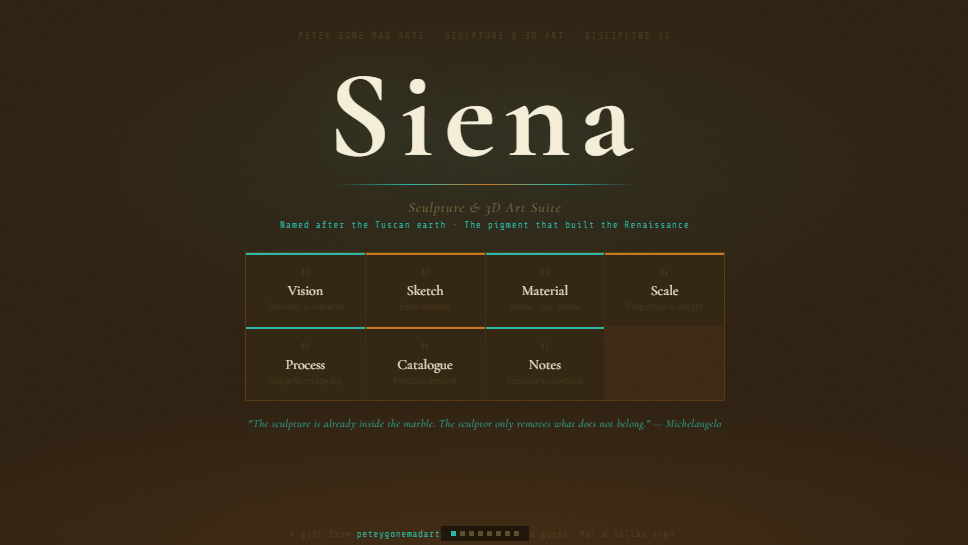
SIENA
The Sculpture & 3D Art Suite
There is a child right now pressing their thumbs into a piece of clay for the first time. Not making anything yet. Just feeling what it does. How it gives. How it holds the impression of a fingerprint like it was waiting to hold exactly that. Something in that child goes completely still. They don't know yet what that stillness means. They will spend their life finding out.
And there is a sculptor right now standing in front of a raw block of Carrara marble — white to blue-grey, grain running diagonally at roughly thirty degrees — reading it the way a surgeon reads an X-ray. Looking for what's inside. Not deciding what to put there. Finding what is already there and removing everything that isn't it.
Michelangelo said that. Not as a metaphor. As a technical instruction.
Siena was built for both of them.
Named after raw sienna — the Tuscan earth pigment that has been ground from the hills outside the city of Siena since before the Renaissance. Not a color invented in a laboratory. A color found in the ground. Dug out, dried, and given to artists who used it to build the warmth into every painting that defined western civilization for five hundred years. The pigment that built the Renaissance. The earth itself, made into art, made into the name of this suite.
A name like that carries obligation. This tool answers it.
Eight tools. The complete sculptor's toolkit — from the first vision inside the raw material to the last bolt anchoring a commissioned piece to its permanent foundation.
Vision — The most original tool in the entire PGMA universe. Load a photograph of your raw material — a stone block, a piece of wood, a lump of clay on the bench — and draw directly over it on a transparent layer with independent opacity controls. Four views: Front, Side, Back, Composite. Five drawing tools: Line, Curve, Contour, Hatch, Erase. Stroke weight control. Undo. Export as a composite PNG that merges your drawing with the photograph beneath it. The tool that makes the invisible visible — because every master sculptor has always said the same thing about the process of carving, and now there is a tool that takes that idea literally. You see the form inside the material before you touch the material. That is where the work begins.
Sketch — Form study canvas for maquette planning and gesture work. Seven drawing tools including Block and Sphere specifically for thinking in three dimensions on a two-dimensional surface. Four palette colors. Export as PNG. The difference between the Vision tool and this one is the same as the difference between reading a block of stone and working on paper — both are necessary, neither replaces the other.
Material — A library of thirteen materials across stone, clay, metal, wood, and found objects — each entry written with technical accuracy that only comes from genuine knowledge. Carrara marble with its grain direction and polishing progression. Limestone, granite, soapstone. Stoneware clay, terracotta, oil-based clay. Bronze with its lost-wax process and patination chemistry. Welded steel. Aluminum. Hardwood. Softwood. Found objects and assemblage. Every entry includes the tools required to work it, how the material behaves under pressure, and what it will not forgive. Plus a personal materials palette where you log your own blocks, pieces, and found objects by name, source, dimensions, and what you see in them.
Scale — Maquette to final scale converter with seven ratio presets from 1:2 through 1:20 plus custom entry, across centimetres, inches, and millimetres. And a weight estimation calculator using actual material densities — marble at 2.7 g/cm³, bronze at 8.9, steel at 7.8, hardwood at 0.6. The tool that prevents a sculptor from completing a maquette and then discovering the full-scale piece weighs four tons and cannot be moved through the studio door. The mathematics of three-dimensional thinking, built in.
Process — Stage-by-stage production log. Title, stage number, stage name, date, what was done, tools used — and what was discovered. That last field is the detail that makes this tool exceptional. It treats the making as a conversation between sculptor and material, not a task checklist. The moment the form revealed itself. The decision that changed everything. The mistake that became the piece. All of it recorded, in order, in the sculptor's own words.
Catalogue — Six-slot portfolio archive with material tags, series naming, and captions. Stored locally. Nothing uploaded anywhere. Your work stays yours.
Notes — The sculptor's private notebook. Eight categories: Form Idea, Material Observation, Technique, Composition, Reference, Studio Note, Surface & Finish, Personal. Brancusi kept notes. Giacometti filled notebooks with observations about the impossibility of capturing the human form. Rodin wrote about the surface of things. The sculptor's notebook is where the work thinks before the hands begin.
Reference — One tap from the cover. The complete technical manual in two parts:
Armature & Structural Support — Wire armature from gauge selection through wrapping technique for every scale of work. Pipe and angle iron for large-scale figures. Clay-specific structural rules — wall thickness, the drying protocol that prevents surface cracking, the hollowing requirement for kiln firing and what happens when it is skipped. The structural principles for large freestanding work including center of gravity, base footprint, and wind loading for outdoor pieces. The rule about public installation that is not optional: engineering sign-off before placement. Not a recommendation. A legal and safety requirement.
Finishing, Display & Installation — Stone surface finishing from pitching chisel through 3000-grit polish with every finish type named and the sealing guidance for outdoor work. Clay and ceramic firing temperatures across earthenware, stoneware, and porcelain. Bronze patination with specific chemicals, their results, and the safety requirements for working with acid patinas. Renaissance Wax as the conservation standard. Wood finishing from oil through lacquer. Pedestal height — why the center of the work should sit at eye level and what happens to the viewer's relationship with the piece when it doesn't. Transport protocol including the acid-free tissue rule that protects finished surfaces from condensation damage. Public installation from site assessment through frost-line foundation depth through anchor bolts cast before the concrete sets. And the full pricing and selling guide for three-dimensional work — why sculpture pricing is structurally different from two-dimensional work, the formula that accounts for material cost, production cost, foundry fees, and hourly rate, bronze edition pricing with artists' proofs and foundry certificates, installation quoted separately always, and the commission payment structure that every sculptor who has ever been left holding a finished piece learns eventually: never deliver before final payment.
From the child pressing their thumbs into clay for the first time, to the sculptor reading the grain of a Carrara block for the last possible angle before the first chisel mark — Siena covers the full distance.
This is what PGMA is.
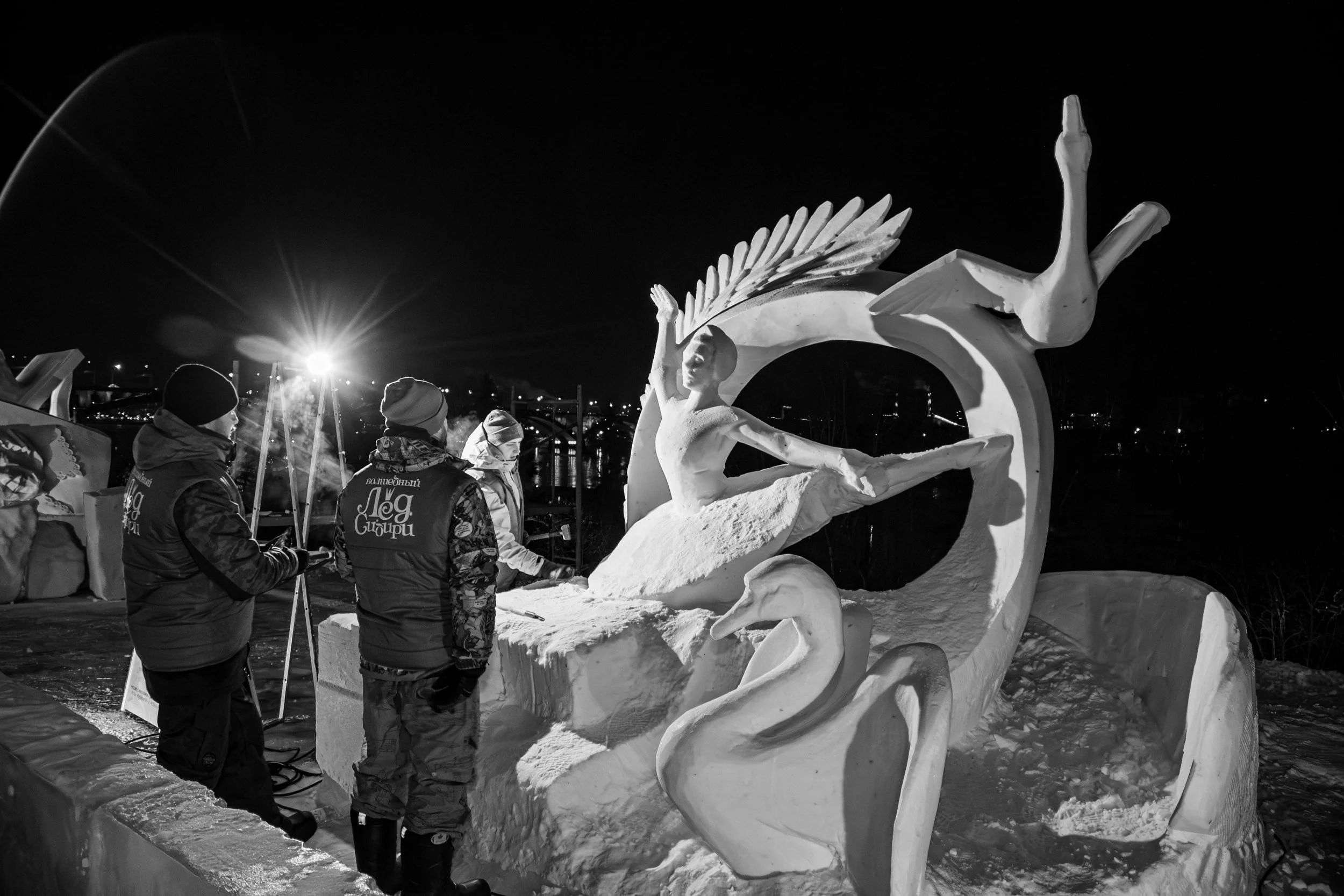
Named after an earth pigment because this discipline begins in the earth — in stone dug from a hillside, in clay pulled from riverbed, in ore smelted and poured and cooled into something that will outlast everything the sculptor ever said out loud. The oldest art form. The most permanent. The one that fills cathedrals and public squares and the silence of museums where people stand in front of a piece of marble and forget what century they're in.
This tool was built to serve that work. All of it. At every scale. From the first fingerprint in clay to the last bolt in the foundation.
Free. No account. No email. No strings.
You are our guest. Not a dollar sign.
Sculpture is the only art that shares physical space with you.
It occupies the same world.
You can walk around it. Touch it. Cast a shadow on it.
This room belongs to the people who made something that stands.
Be the one who shapes it.
If sculpture is yours — share what you've built.
Pete will study it personally.
Thank you for being here.