Got everything I need. Let me write it.
OSCAR
The Complete Film & Video Production Suite
There is a kid right now with a phone, a story, and no idea where to start. The camera is already in their pocket. The question is not whether they have the tools — they do. The question is whether anyone is going to tell them how to use them.
And there is a filmmaker right now — script locked, crew assembled, investors asking questions, festival deadlines circled on a calendar — who knows exactly how thin the margin is between a film that gets made and a film that gets abandoned in a hard drive. The difference is rarely talent. It is almost always preparation.
Oscar was built for both of them.
Named after the Academy Award. Not as a promise. As an aspiration. The gold statue that has represented the highest achievement in cinema for nearly a century — the thing every person who ever picked up a camera and pointed it at the world has somewhere in the back of their mind, even when they'd never say it out loud. Oscar lives in this app because the goal lives in the work. Even if the film is a short. Even if the camera is a phone. Even if the budget is zero. You commit to the craft or you don't. There is no middle position.
This suite was built by a man who understands film — not as a consumer, but as a student of the discipline. Someone who knows the difference between a T-stop and an f-stop, between a sync license and a master license, between a VFX supervisor who is on set before principal photography and one who shows up in post to fix problems that should never have existed. The knowledge in Oscar is not assembled from a list of things that sounded useful. It is built from understanding what a production actually needs, at every stage, at every budget level, from the first sentence of a logline to the moment a distribution deal lands on the table.
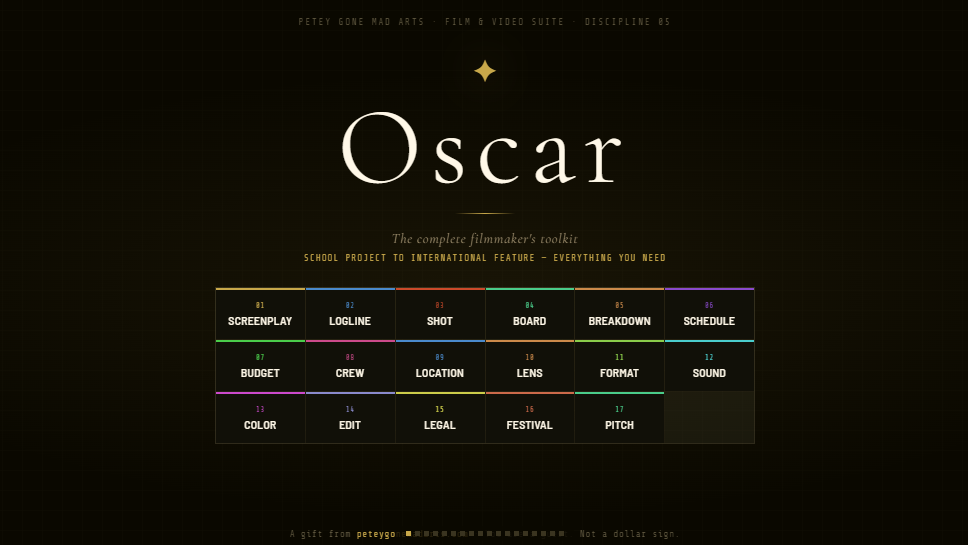
Eighteen tools. The complete pipeline.
Screenplay — Industry standard script format. Scene headings, action lines, dialogue, parentheticals, transitions. The format that every reader in Hollywood expects and every filmmaker who takes their work seriously uses, because format is respect for the reader's time.
Logline — One sentence. Protagonist, want, obstacle, stakes. Hollywood reads thousands per week. Yours has five seconds. The logline builder walks you through every element and assembles it. Get this right and everything else has a foundation.
Shot — Professional shot list builder. Scene number, shot number, description, shot type, camera movement, lens, lighting, VFX notes, duration. The document that turns a script into a shooting plan.
Board — Storyboard panel planner. Visual description, camera action, audio cue, mood notes per panel. The tool that communicates your visual plan to the entire crew before a single frame is shot. Even rough sketches save production time and money.
Breakdown — Script breakdown by scene. Cast, extras, props, costumes, vehicles, special equipment, VFX, animals. Every element identified before shoot day so nothing is discovered missing at 6am on location.
Schedule — Production schedule builder by shoot day. Date, call time, wrap time, location, scenes, cast required, special notes. The document that turns a breakdown into a calendar.
Budget — Full production budget tracker across every department — story and rights, producing, directing, cast, camera, art, wardrobe, hair and makeup, lighting, grip, sound, locations, transportation, catering, VFX, editing, color, sound mix, music, deliverables, insurance, legal, marketing, festival fees, contingency. The real categories. Not a simplified version.
Crew — Crew list and department organizer. Role, name, contact, rate, deal terms. Every department accounted for, every person documented, every deal recorded.
Location — Location scouting log. Name, address, status, contact, fee, power access, parking, sound issues, permit requirements, scout notes. The tool that turns a walk-through into a production record.
Lens — Cinema lens reference guide using T-stops, not f-stops, because that is how cinema glass is rated and that is what consistency across multiple cameras requires. Focal length reference, anamorphic vs spherical, depth of field guide at every T-stop. Built correctly.
Format — Camera and format reference. Every major cinema camera and recording format. Aspect ratio reference. Codec and recording format guide — RAW, LOG, Rec.709, H.264, H.265 — what each means, when to use it, and what it costs you in post. The rule of thumb stated plainly.
Sound — Production sound reference and checklist. Pre-production sound checklist, boom vs lavalier guidance, and the common sound mistakes that kill productions — because more films are unwatchable due to bad audio than bad picture, and most of those problems were preventable on the day.
Color — Color grading reference. Every color space explained. LUTs — technical, creative, and delivery — defined correctly. What to tell your colorist. The one thing the colorist cannot fix no matter how good they are.
Edit — Post production timeline planner. From assembly cut to picture lock to delivery. Every stage documented with the VFX manual built in — because the edit and the VFX pipeline are inseparable, and every filmmaker who has waited six weeks for a VFX shot to come back knows why that manual belongs here.
Legal — Rights and clearances reference. Every document you need before you shoot. The music licensing rule that kills more films than any other single issue — two licenses, not one, always. Fair use as a defense not a shield. Logos, trademarks, chain of title. A clearance tracker that saves to your browser.
Festival — Film festival submission guide. DCP specifications, streaming submission specs, what festival programmers actually look for, major festival tiers and deadlines — and the full Distribution & Delivery manual built in. Because the festival is not the finish line. It is the beginning of the next conversation. Every distribution type explained, delivery requirements for the major streaming platforms, aggregators, and the deal terms that separate a filmmaker who kept their rights from one who signed them away for nothing.
Pitch — Full pitch package builder. Title, genre, runtime, logline, synopsis, director's statement, comparable films, target audience, budget range, current status, key bios. Build the document. Export it. Hand it to the person across the table and know that it says everything it needs to say.
Callsheet — The document that runs a set. Production info, location, nearest hospital, general call, crew call, camera roll, estimated wrap, weather, scenes scheduled, cast call times with individual makeup and set calls, department calls, catering, equipment and advanced items, safety notes, production notes. Build it, render it on screen, export it as a text file. The night before every shoot day, this goes to every department. Nothing happens on a set without it.
From the kid with a phone and a story they need to tell, to the filmmaker negotiating a streaming deal for a film that started as a conversation — Oscar covers the full distance. Eighteen tools. Every stage. No stage left out.
This is what PGMA is.
The film school that costs nothing. The production office that fits in your pocket. The knowledge that used to live behind tuition fees and industry connections and years of getting it wrong, now freely given to anyone willing to do the work.
No account. No email. No strings. The camera is already in your hand.
You are our guest. Not a dollar sign.
Film is the most democratic art form ever created.
One frame can change a generation.
One story can make a stranger feel less alone.
This room belongs to the people who pointed the camera and pressed record.
Be the one who calls action.
If film is yours — share what you've made.
Pete will watch personally.
Thank you for being here.