BALBUS
The Architecture & Design Suite
There is a person standing on a wooded lot right now. Three acres. Dense tree cover. A creek running along the eastern edge. They are trying to imagine a house. They are turning slowly, looking at the trees, looking at the light coming through the canopy, looking at the slope of the land — and they cannot see it. Not because the vision isn't there. Because the tools to make the invisible visible do not yet exist in the palm of their hand.
They will.
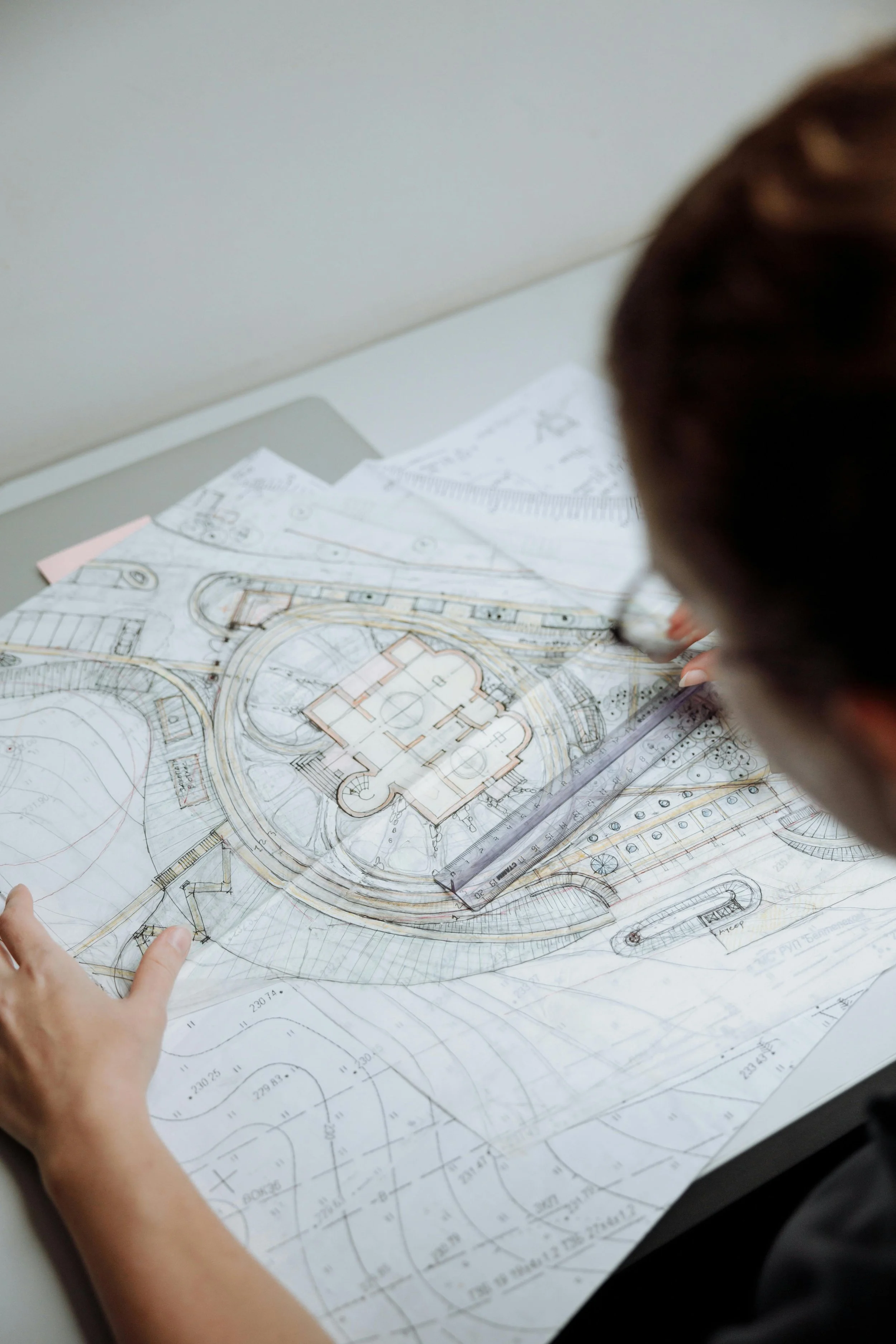
And there is an architect right now at a drafting table — or a screen, which is what drafting tables became — working on a site analysis for a project that is still entirely in the future. Zoning constraints, setback requirements, floor area ratio, solar orientation, existing vegetation, adjacent context, opportunities, and constraints. All of it mapped before a single line of design is drawn. Because the site is not a blank canvas. It never was. It has climate, topography, orientation, history, and a specific quality of light at 4pm in November that will determine whether the main living space works or doesn't. Great architecture begins with reading the site before drawing anything.
Balbus was built for both of them.
Named after Balmes — philosopher, 1810 to 1848. The man who described the megagon. A shape with one million sides that is, to the human eye, mathematically indistinguishable from a circle. You cannot see the difference. But the engineer knows every single one of those lines exists. Every angle. Every vertex. The circle is an approximation. The megagon is the truth behind it. The engineer who sees every line in what looks to everyone else like a curve — that is Balbus. That is the discipline. That is the person this tool was built for.
Engineering is art. The megagon proves it.
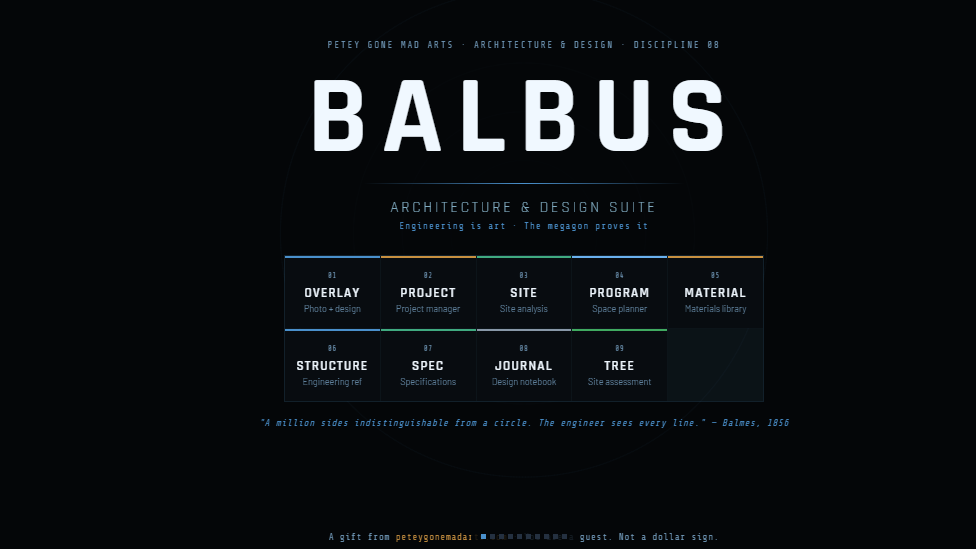
Nine tools. The complete architecture and design pipeline — from the first photograph of a raw site to the final specification document that tells a contractor exactly what to build and to what standard. For the student sketching their first floor plan. For the licensed architect managing a two-million-dollar commission. For the homeowner who wants to understand what they are looking at before they sign anything. The same tool. The same standard. Because the discipline does not simplify for anyone.
Overlay — The heart of Balbus. Load a photograph of your site. Any photograph. The wooded lot, the empty field, the urban infill parcel, the existing building you intend to renovate. Draw architectural concepts directly over the photograph on a transparent layer with independent opacity control on both the photo and the drawing. Seven drawing tools: Line, Building, Circle, Dashed boundary, Arrow, Fill Zone, Erase. Five colors. Three completely independent concept layers — A, B, C — each holding their own stroke history. Switch between concepts without erasing anything. Compare three entirely different design directions against the same site photograph simultaneously. Export any concept as a composite PNG — the photograph and the drawing merged into a single image that can be shared with a client, a planning board, a contractor, or anyone else who needs to see what the designer sees.
This is version one. This is what is possible today.
What this tool becomes — when the technology catches up — is not a photograph and a drawing layer. It is the live camera feed. You stand on the wooded lot. You point the phone. The house appears in the trees. Not a sketch over a still image. The building, rendered over the actual landscape, in real time, through the screen in your hand. The family van in the driveway. The landscaping around the foundation. The garden where the garden will be. All of it laid over the real site as your eye sees it, in the moment you are standing there.
That technology — WebXR, ARCore on mobile web, consumer-grade geospatial anchoring — exists in pieces right now and is advancing every month. The gap between what Balbus does today and what Pete envisions is not a gap in the idea. It is a gap in the world's readiness. The idea has been complete since the day he said it:
"I can see it will be able to eventually in real time lay a home, landscaping even family van in driveway while looking at a completely wooded lot. Or a gardener with a customer could do same. A tree service in real time shows the limb, tree or trees gone. Balbus is the visualization of what can be compared to what is."
That sentence was not written in a meeting. It was not the result of a brainstorm or a feature planning session. It arrived unprompted, fully formed, from the man who built the frame before the glass was made. The glass is being made. When it arrives, the frame is ready. The tool is ready. The vision was always ready.
Pete is waiting on the technology to catch him.
Project — Full project manager for architectural work. Project name, type across fourteen categories from single-family residential through urban planning, status through the full development pipeline, budget, client, location, dates, program summary, design vision statement, and key consultants. Save multiple projects. Export any project as a complete document.
Site — Site analysis tool built from real architectural practice. Site area, zoning designation, allowable FAR, setbacks, easements. Solar orientation with eight cardinal and intercardinal directions. Topography, climate zone, existing vegetation, adjacent context. Opportunities and constraints documented in full. Because the site analysis is not paperwork — it is the first design decision.
Program — Architectural space planner. Add every space required — name, area in square feet, quantity, category, adjacency requirements, and special needs. Live running totals for net area and gross area with the industry-standard 1.3x circulation factor applied automatically. Export the full program as a document. The architectural program is the complete answer to the question: what are we actually building and how much room does it need?
Material — Materials library across concrete, masonry, steel, wood, glazing, and finishes — each entry with structural properties, typical applications, and specification notes. Plus a personal project material palette where you log every material choice by name, specification grade, color, and application notes. The record of every material decision made on a project, in one place.
Structure — Structural systems reference covering the major structural approaches — timber, steel frame, concrete, masonry bearing wall, long-span systems. The information an architect needs to work fluently with a structural engineer. Plus a preliminary beam sizing calculator — enter span and load, receive a starting point for structural conversation. Because the structure is never just engineering. The Pantheon is a dome. The Eiffel Tower is a lattice. The Sydney Opera House is a series of shell vaults. The structure is the architecture.
Spec — Project specifications tool built around the CSI MasterFormat division system — the international standard for construction specification organization. Division 03 through Division 09. Specification section, applicable standard, material specification, workmanship requirements, submittals required, notes. The document that accompanies the drawings. Drawings show what to build. Specifications describe how to build it and to what standard. A set of drawings without specifications is an incomplete set of construction documents.
Journal — The design journal. Date, project, entry type — Concept, Observation, Site Note, Meeting, Reference, Sketch in Words, Personal. The full entry. Saved, filtered, exported. Le Corbusier's sketchbooks. Louis Kahn's notes. Frank Lloyd Wright's autobiography. The design journal is where the thinking happens before the drawing. The throwaway idea of Tuesday becomes the breakthrough of Thursday. Write everything.
Tree — The tool that belongs to everyone who has ever stood on a wooded lot and tried to communicate to a client, a crew, or a municipality exactly which trees stay and which go. Load a site photograph. Tap to place color-coded markers: Remove in red, Keep in green, Trim in yellow, Hazard in orange, Note in blue. Each marker numbered and labeled. Adjustable size. Export generates a composite PNG with a full legend strip and the line that protects everyone involved: Client approval required before work begins. For tree services, landscapers, site contractors, arborists, and anyone whose work begins with the existing landscape and ends with a decision about what remains.
From the person standing on the wooded lot trying to see the house that isn't there yet, to the architect producing construction documents for a building that will stand for a hundred years — Balbus covers the full distance. And then it waits, patiently and deliberately, for the distance to extend further.
This is what PGMA is.
One man, one laptop, one vision that arrived complete before the world had the tools to execute it. He built what was possible today and left the door open for what becomes possible tomorrow. Not as a placeholder. Not as a promise. As a demonstration that the idea came first and the technology will catch up — because it always does, and because the people who build the frame before the glass is made are the ones the world eventually calls visionary.
The frame is built. It is standing on the lot. The glass is being made.
Free. No account. No email. No strings.
You are our guest. Not a dollar sign.
Balbus is the visualization of what can be compared to what is.
A building is a thought made permanent.
Architecture is the art that outlives everyone.
The Pantheon has stood two thousand years.
No painting, no song, no film has held that long.
This room belongs to the people who build to last.
Be the one who lays the foundation.
If architecture is yours — share what you've built.
Pete will study it personally.
Thank you for being here.