LIZ
The Professional Fashion & Textile Design Suite
There is a girl right now who has been altering her own clothes since she was twelve. Taking in seams. Raising hems. Turning something that almost fit into something that did. She doesn't call it design yet. She just knows she sees what the garment could be, and her hands know how to get it there. She is already a designer. She just hasn't been told.
And there is a designer right now — collection in development, a vision that exists fully formed in her mind and only partially on paper — who understands that the distance between the idea and the finished garment is one of the most demanding distances in any creative discipline. It requires the eye of an artist and the precision of an architect. It requires knowing not just what something should look like but how it must be built to become that.
Liz was built for both of them.
Named in honor of Elizabeth Taylor.
Not simply because she was beautiful — though she was, in a way that stopped rooms and silenced sentences and made people forget what they were about to say. Because she understood clothes the way only a woman with absolute personal authority can. What she wore was never separate from who she was. The violet eyes, the Bulgari, the Dior, the Halston — these were not costumes. They were language. She dressed the way she lived: with complete intention, complete presence, and not a single concession to anyone else's idea of how she ought to appear.
That is what this suite is named after. Not fashion as performance. Fashion as self-possession.
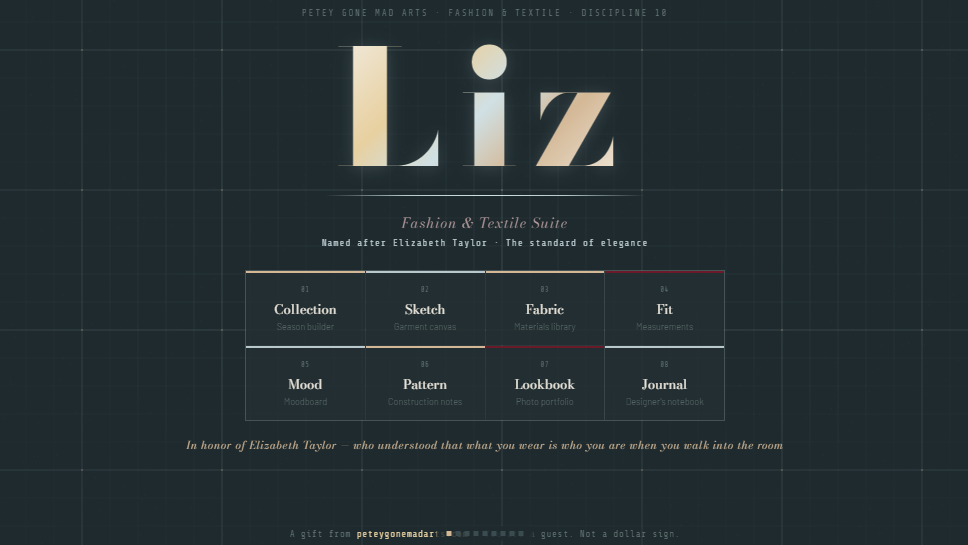
Eight tools. The complete designer's toolkit.
Collection — Season builder. Name, season, year, number of looks, creative concept, color palette, key fabrics, key silhouettes, inspiration references. Save multiple collections. Export any collection as a complete document. The place where the vision becomes a record before it becomes a garment.
Sketch — A garment canvas with six drawing tools — Line, Curve, Panel, Ellipse, Stitch, Erase — in four views: Front, Back, Detail, and Flat Lay. Five palette colors drawn from the Liz aesthetic. Stroke weight control. Undo. Export as PNG. And a Croquis — tap to overlay the elongated nine-head fashion figure directly onto the canvas, with the nine proportion marks visible, so every sketch begins from the correct proportional foundation. Toggle it on or off. Sketch over it or beside it. It is there when you need it.
Fabric — A materials library with twelve reference fabrics across silk, wool, cotton, linen, synthetic, lace, and velvet — each with weight in GSM, fiber composition, handling notes, and honest warnings about how each material behaves under pressure. Plus a personal fabric palette where you log your own selections by name, color, weight, supplier, and notes. Export the full palette.
Fit — The most important tool in the suite, because the fit is the garment. Seventeen body measurements captured per client or model — bust, waist, hip, shoulder, back length, front length, sleeve, inseam, outseam, neck, thigh, knee, calf, ankle, wrist, bicep, head circumference. Metric or imperial. Save unlimited client profiles. Load them by name. Export as a text file. The most expensive fabric in the world worn poorly is nothing. The simplest cloth cut and fitted with precision is everything.
Mood — Fashion moodboard builder. Nine image slots for visual reference. Color palette notes. Texture reference notes. Collection and direction fields. The board that exists before the collection exists — the visual language assembled before the first pattern piece is cut.
Pattern — Construction notes for every pattern piece. Name, garment reference, seam allowance, grain line, ease, sizes to grade, full construction sequence in order, special notions and hardware, notes. Save unlimited patterns. Export all as a single document. A pattern is the translation of a three-dimensional idea into flat geometry. Every seam is a decision. Every dart is a negotiation between the body and the cloth.
Lookbook — Six-slot photo portfolio. Aspect ratio 3:4 — the proportion of a fashion image. Caption with look title, season, fabric, notes. Season badge per image. Stored locally. Nothing uploaded anywhere. The visual record of a career, curated by the person who made the work.
Journal — The designer's private notebook. Ten entry categories: Collection Idea, Silhouette, Fabric Observation, Color, Cultural Reference, Street Observation, Client Note, Trend, Technical, Personal. Filter, save, export. Coco Chanel kept notebooks. Yves Saint Laurent filled sketchbooks with words as much as drawings. The designer's journal is where the collection exists before it exists — in language, in fragments, in a color seen through a window on a train.
And inside the Journal, three complete reference manuals — the knowledge that belongs in every designer's hands:
Manual — Care & Garment Instructions. Every laundry symbol explained in plain language. Fabric-specific care guides for silk, wool, cashmere, linen, velvet, and lace. The care label writing guide with the international sequence, fiber content requirements, and what EU law requires on any garment sold commercially.
Manual — Color Theory & Seasonal Palette. The color wheel and its relationships — complementary, analogous, triadic, split-complementary, monochromatic. Warm and cool undertones and why two beiges can look wrong together. The seasonal color system applied to fashion. The rule of three for collection palettes. How fabric finish changes how color reads. And the truth about black — not the absence of color, but one of the most deliberate decisions in fashion.
Manual — Sourcing & Garment Costing. The full cost of goods formula with every line itemized honestly — fabric, lining, notions, labor, overhead. Three pricing strategies with the math. Where professionals source fabric — Première Vision, Texworld, the fabric districts of New York, London, Paris, Tokyo. Minimum order quantities at every level. Notions suppliers. And the one line that every designer who has ever underpriced their work needed to hear earlier: a garment priced too low signals the wrong things about the work. Price with intention.
From the girl taking in seams at twelve, to the designer dressing the women who define their era — Liz covers the full distance.
This is what PGMA is.
The atelier that costs nothing to enter. The knowledge that used to live behind fashion school tuition and industry access and years of expensive mistakes, now given freely to anyone with the vision and the discipline to use it.
No account. No email. No strings.
You are our guest. Not a dollar sign.
Fashion is the art form that walks into the room before you do.
It speaks before you open your mouth.
Every thread is a decision. Every silhouette a statement.
This room belongs to the people who dressed the world.
Be the one who cuts the cloth.
If fashion is yours — share what you've made.
Pete will look personally.
Thank you for being here.