PRAN
The Professional Photography & Photojournalism Suite
There is a student in a darkroom right now, hands in developer, watching an image appear on paper in the dark for the first time. There is nothing else like that moment. The image was always there — latent, waiting — and now it is real. That student is learning something that has nothing to do with technology. They are learning to see.
And there is a photographer in the field right now — camera set to full manual, black and white RAW, no safety net, no auto anything — who knows that every decision belongs to them. Aperture. Shutter. ISO. Light. Frame. The machine does nothing. The eye does everything.
Pran was built for both of them.
Named in honor of Dith Pran — Cambodian-American photojournalist, survivor of the Cambodian genocide, witness to history, 1942–2008. The Killing Fields was the first film Pete ever saw alone. It left a mark that never healed and never should have. Pran carries his name because the name deserves to be carried. So does the weight behind it.
Alongside Pran, another name shaped this suite — Ernst Leiter. Not just referenced. Studied. Absorbed. Present in the preference for black and white, in the discipline of a single frame, in the understanding that restraint is not limitation — it is mastery.
This suite was not assembled from a list of features someone thought sounded useful. It was built by a man who took black and white photography and journalism photography in high school — who learned to read light before he learned to read a histogram. Who returned to the discipline 35 years later and completed his full Photography Certification through Michigan State University. Go Spartans. Whose capstone work and coursework named Pran and Leiter not as historical footnotes but as foundational influences — visible in his style, visible in his preference for black and white, visible in the way he shoots.
A Canon Rebel T5. Always on full manual. Always black and white RAW. Not because the equipment demands it — it doesn't. Because the photographer demands it of himself. The camera is a tool. The eye is the instrument.
The tools in this suite are the tools Pete did not have when he needed them — built from what he knew then and everything MSU taught him he was still learning. They exist now so you don't have to learn the hard way what took thirty-five years to accumulate.
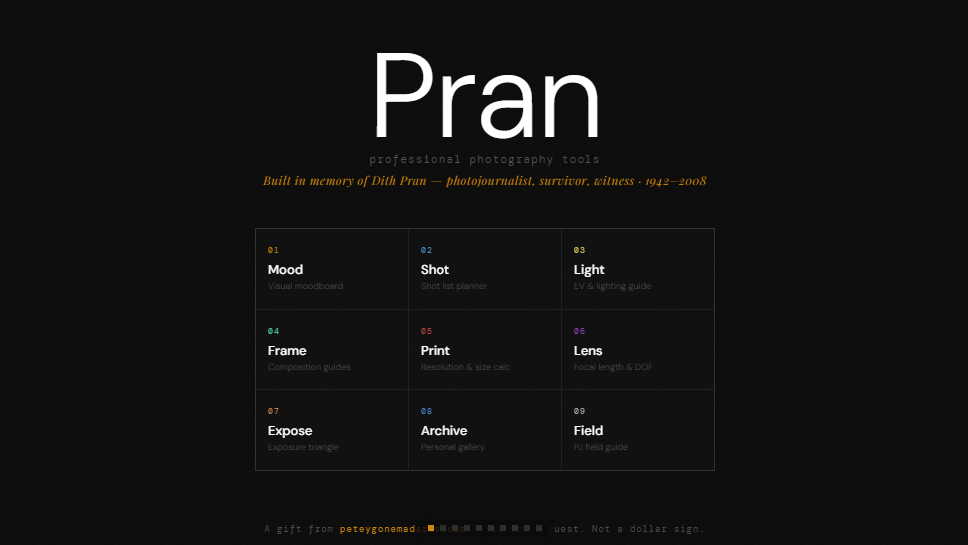
Mood — Visual moodboard builder for project planning. Upload reference images, set your format, document your visual direction before you ever load a card.
Shot — Professional shot list planner. Lens, aperture, light condition, notes per shot. Check off completed shots. Export the full list. The tool that separates a photographer who shows up from one who arrives prepared.
Light — Full EV chart covering thirteen lighting conditions from moonless night to bright sand and snow. Tap any scene for recommended starting exposure. Because light is not one thing — it is a hundred different decisions depending on where you are standing.
Frame — Seven composition guides drawn live on canvas — Rule of Thirds, Golden Ratio, Diagonal, Centre Weight, Negative Space, Frame in Frame, Leading Lines. Five aspect ratios. The visual grammar of photography, interactive and at your fingertips.
Print — Resolution and print size calculator. Nine standard presets from 4×6 to 40×60. Custom dimensions. Four DPI settings. Pixel dimensions, megapixel requirements, minimum camera resolution. The math that stands between a good photograph and a great print.
Lens — Focal length reference from 14mm to 400mm+. Tap any length for type, use case, and crop equivalents across Full Frame, APS-C, MFT, and phone sensors. Real depth of field calculator — near focus, far focus, total DOF, hyperfocal distance. The 35mm reference note reads: Dith Pran's era — the workhorse.
Expose — Full exposure triangle. Aperture, shutter speed, ISO selectors with live EV readout, exposure analysis, and a complete grid of equivalent combinations. The triangle is not a theory. It is the only tool the photographer actually has.
Archive — Six-slot personal photo gallery. Captions, titles, categories. Stored locally. Nothing uploaded anywhere. Your work stays yours.
Field — The photojournalist's complete field guide and reference manual. Photographer's rights in plain language. Ethics in the field — including Dith Pran's decision to stay behind, which defines what photojournalism is. A 20-item gear checklist with persistent check state. Safety in the field. And three complete manuals built into the guide itself: White Balance & Color Temperature, Post-Processing & the Edit, and Camera Systems & Sensor Formats — the knowledge that many sites offer for free and that PGMA will offer as well, because that is the whole point.
From the student in the darkroom watching their first print develop, to the photojournalist in the field who knows that bearing witness is a responsibility that outlasts the frame — Pran covers the full distance.
This is what PGMA is.
The tools you didn't know you needed when you needed them, built by someone who knows now what he was still learning then. Freely given. No account. No email. No strings.
You are our guest. Not a dollar sign.
The camera does not lie.
It only reveals what was always there.
Every photograph is a decision —
what to include, what to leave out, when to press.
This room belongs to the people who made that decision count.
Be the one who captures it.
If photography is yours — share what you've captured.
Pete will look personally.
Thank you for being here.