MACBETH
The Complete Theatre & Performance Suite
There is a child right now in a school gymnasium, standing on a stage made of masking tape on a linoleum floor, holding a script with both hands, about to say their first line in front of an audience for the first time in their life. Their heart is going. They don't know yet what this feeling is. They will spend the rest of their life chasing it.
And there is a stage manager right now in the wings of a Broadway house, headset on, prompt book open, two minutes to curtain, sixty-four cues queued, a company of thirty-two people waiting for a single word from her. She has done this three hundred times. Her heart is still going. That never leaves either.
Macbeth was built for both of them.
Named after The Scottish Play.
Say the name inside a theatre and tradition demands you leave, spin three times, spit, curse, and knock to be let back in. Actors have observed this superstition for four centuries. Not because they are irrational. Because they understand something fundamental about the relationship between language and power — that some names carry weight that ordinary words do not, and that weight must be respected or it will find a way to make itself felt.
A tool named after The Scottish Play should reflect that.
This one does.
Ten tools. The complete production pipeline from the first word on the page to the last person in the audience going home — for the school production, the community theatre, the regional house, and the Broadway stage. Not a simplified version for some of those and a professional version for the others. One tool. Built to the highest standard. Because the child on the masking tape stage deserves the same respect as the company in the Broadway house, and because the discipline is the same at every level. Only the budget changes. The craft does not.
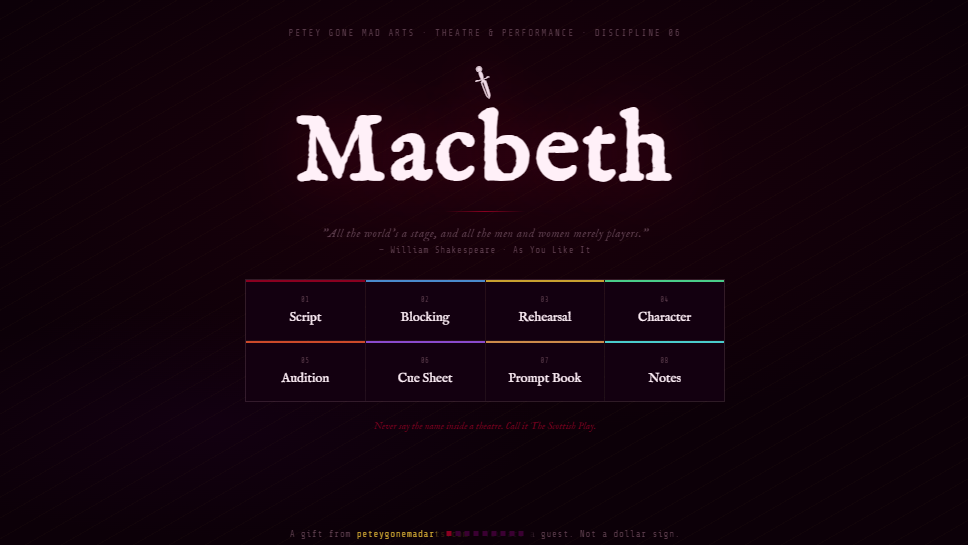
Script — Stage script formatter with Act, Scene, Stage Direction, Character, and Dialogue structure. Live word count, act count, and scene count as you write. Export the complete script as a text file. Because every production begins with words on a page, and the words on the page need to be organized before anyone can speak them.
Blocking — Live stage diagram drawn on canvas with four configurations — proscenium, thrust, traverse, and in-the-round. Full stage position reference built in. Complete blocking notation system. Notes saved by act, scene, page, and line. Because movement is the other half of the language of theatre, and someone has to write it down before anyone can repeat it.
Rehearsal — Complete rehearsal scheduler with fourteen rehearsal types from Table Work through Fight Call and Dress Rehearsal. Date, time, location, scenes, cast called with character and actor names. Because respecting the company's time is not a courtesy — it is a professional obligation, and a schedule that calls only the actors needed for each scene is the first signal that a production knows what it is doing.
Character — The actor's private working document. Super-objective, objective, obstacle, arc, secrets, relationships, physical life, and personal notes. Built from the inside out, the way Stanislavski intended, because the better you know your character, the less you have to act.
Audition — Complete audition tracker and callback manager. Name, roles, date, time slot, status, material prepared, director's notes. Because auditions are the first creative decisions of a production, and those decisions deserve a record.
Cue Sheet — The technical spine of the production. Eight cue types: LX, SQ, FLY, FX, SPOT, VIDEO, AUTO, SM. Cue number, script reference, description, standby, go line, fade timing. Because nothing happens on a stage without a cue, and the stage manager who calls the show needs every cue documented to the exact word that fires it.
Prompt Book — The most important document in theatre. The stage manager's master record. Production title, opening and closing nights, venue, run time by act, pre-show checklist, daily rehearsal report. If the theatre burned down, the prompt book would allow the production to be reconstructed from scratch. That is not hyperbole. That is the definition of the document.
Notes — Performance and rehearsal notes with four priority levels: Note, Urgent, Safety, Positive. Specific, actionable, directed toward the work and not the person. Because notes given after every rehearsal and every preview are the mechanism by which a production improves, and because the note that changes the performance is always the specific one, never the general one.
Reference — The complete theatre disciplines manual. Who does what — director, stage manager, actor, playwright, the full design team. Every stage type explained with real-world examples. The essential vocabulary of acting, stage management, and technical theatre. And a history of western theatre from the hillside amphitheatres of ancient Athens through Shakespeare's Globe, nineteenth century realism, the revolutionary twentieth century — Brecht, Artaud, Grotowski, Stanislavski — through to the contemporary forms that exist because those four men broke everything that came before them. The roadmap every person needs who walks into a rehearsal room for the first time and feels the weight of four thousand years of practice behind a single night of performance.
Audience — Marketing, front of house, and the discipline of building an audience. The production identity questions that must be answered before any marketing begins. The press release built correctly — structure, rules, timing, who receives it. Programme notes. Social media by platform with honest platform-specific guidance. Front of house from the FOH manager's responsibilities through pre-show announcements, late seating, and accessibility. Ticketing platforms. Funding and grants — where to look, what funders want, and the long-term relationship that keeps them returning. Because a production that no one sees is a rehearsal. The audience is not optional. They are the final collaborator. The work is incomplete without them.
From the child on the masking tape stage to the stage manager with sixty-four cues queued in the Broadway wing — Macbeth covers the full distance.
This is what PGMA is.
A name that carries weight should carry it all the way through. Every tool in this suite was built to reflect what the name demands — the precision, the discipline, the darkness, the beauty, the absolute seriousness of the craft. Theatre is the oldest collaborative art form on earth. It has been killed many times and has always come back, because the need for a body, a space, and an audience gathered in the same room at the same time to witness something together is not a cultural preference. It is a human requirement.
This tool was built to serve that requirement.
Free. No account. No email. No strings.
You are our guest. Not a dollar sign.
Never say the name inside a theatre.
The stage is the only place where truth
is allowed to be performed in plain sight.
Every other art form hides behind a frame.
Theatre walks into the room and stands there with you.
This room belongs to the people who stepped into the light.
Be the one who steps into the light.
If theatre is yours — share what you've performed.
Pete will read it personally.
Thank you for being here.